Cornell Bowers College of Computing and Information Science Cornell
Bowers
Symbiotic Computing Initiative Physical AI for Society

The future of physical AI is symbiotic.

Humans, robots, and machines working in symbiosis to help each other solve some of the most important societal challenges—in homes, on farms, in classrooms, and on factory floors.

Building the computing stack underneath is a decade of research. We are doing it in the open, with the companies who will build on it.

White paper Build with us Open-source Seminar News and events

The Symbiotic Computing Stack

Building this stack will take researchers and practitioners in computer systems, machine learning, robotics, sensing, law, and occupational therapy working in symbiosis. Click on any layer to learn more about projects.

Symbiotic applications

Rachit AgarwalRA Tapomayukh BhattacharjeeTB Mark CampbellMC Tanzeem ChoudhuryTC Manoj KarkeeMK Joel SteinJS Mabel TaracenaMT
Human care Industrial Agriculture Education

Symbiotic control

Rachit AgarwalRA Tapomayukh BhattacharjeeTB Mark CampbellMC Sarah DeanSD Chris De SaCD Bharath HariharanBH

Symbiotic planning

Rachit AgarwalRA Tapomayukh BhattacharjeeTB Mark CampbellMC Sarah DeanSD Chris De SaCD Bharath HariharanBH

Symbiotic perception

Tapomayukh BhattacharjeeTB Mark CampbellMC Chris De SaCD Bharath HariharanBH

Symbiotic data

(collection, simulation,
archive, replay)
Rachit AgarwalRA Mark CampbellMC Tanzeem ChoudhuryTC Udit GuptaUG

Robot OS and runtime

Rachit AgarwalRA Chris De SaCD Udit GuptaUG

Compute and hardware

(compute, memory, sensors, actuators, bodies)

Symbiotic sensing

Tapomayukh BhattacharjeeTB Tanzeem ChoudhuryTC

Symbiotic trust and safety

Rachit AgarwalRA Tapomayukh BhattacharjeeTB Mark CampbellMC Karen LevyKL

Symbiotic evaluation

Rachit AgarwalRA Tapomayukh BhattacharjeeTB Udit GuptaUG Karen LevyKL

Every component is learned — driven by machine learning rather than hand-written rules. Compute and hardware is drawn dashed because we do not plan to innovate there, for now. Trust and safety, and evaluation, run the full height because they constrain and measure everything above them.

The entire stack builds on existing open-source projects. Everything we build returns to the open-source community.

Symbiotic Computing Deployments

Systems our team has taken out of the lab and deployed with real users, in their own environments.

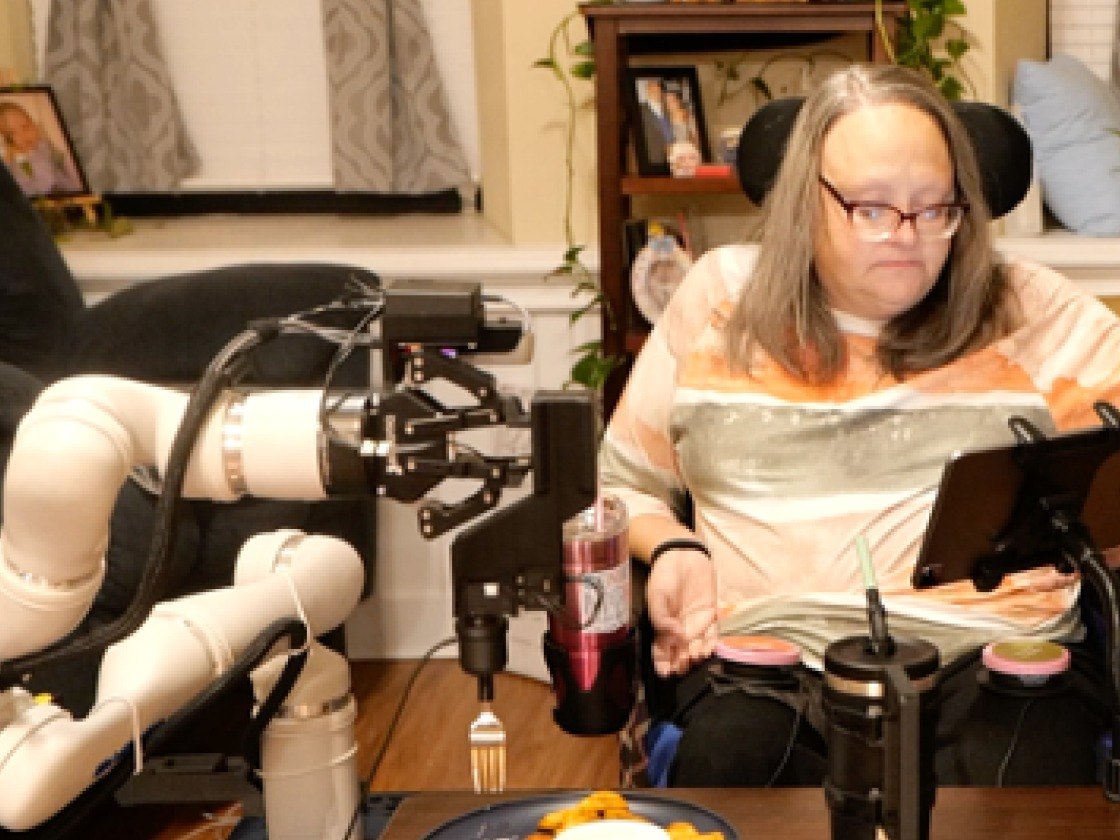
A care recipient using the FEAST mealtime-assistance robot at home

Care: Mealtime assistance

Our deployment, named FEAST, enables care recipients to personalize the robot themselves. FEAST was built over three years of participatory design with Aimee, who has multiple sclerosis, and Benjamin, who has a spinal cord injury. We then deployed FEAST in their homes for five days a year with minimal researcher intervention. A formative study with 21 care recipients surfaced 46 distinct personalization needs; an important learning was that deployment success depends not on more autonomy, but on the user’s ability to re-parameterize the robot without researcher intervention.

Symbiotic control · Two private homes · Three-year co-design, five-day in-home study
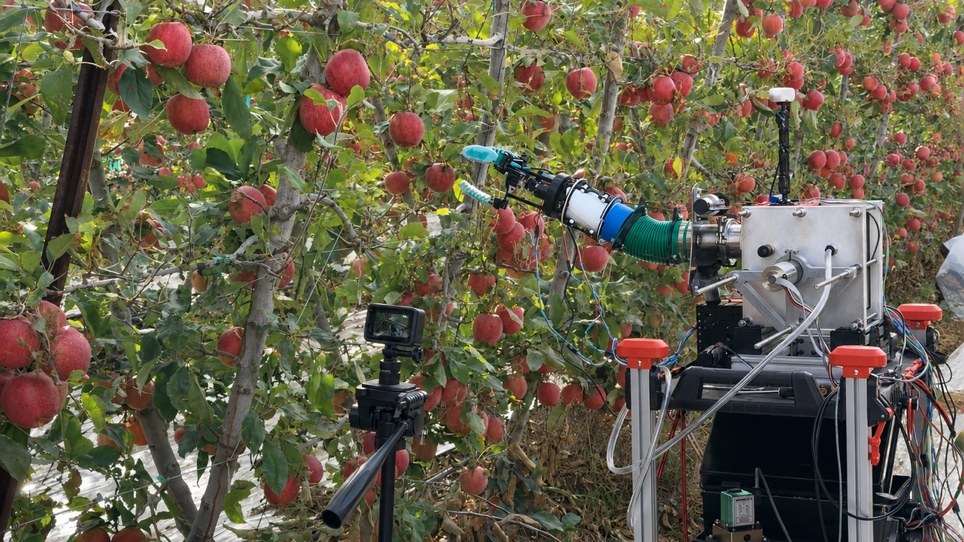
A robotic apple harvester with a soft manipulator picking fruit in a fruiting-wall orchard

Agriculture: Robotic apple harvesting

Fifteen years of machine-vision systems, end-effectors, and integrated robots for apple harvesting—both rigid and soft manipulators—tested in university experimental orchards and commercial orchards in New York and Washington, across a broad range of cultivars and canopy architectures, and progressively improved. The field studies show robots pick accessible fruit very effectively; fruit growing in clusters, or occluded by other fruit, branches, or foliage, remains the challenge. The path to commercial deployability runs through multi-arm collaboration and human–robot collaboration on canopy perception, decision making, path planning, and manipulation.

Symbiotic perception · NY & WA orchards · Fifteen years of field studies
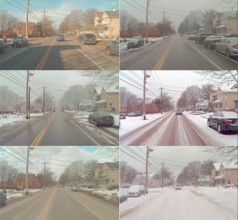
The same Ithaca street seen across six different weather and light conditions

Trust and safety: Perception in all weather

Over fifteen months, an instrumented vehicle drove the same 15km route through Ithaca—urban, highway, suburban, and campus—hundreds of times, across sun, rain, snow, night, and traffic, capturing high-density lidar, camera, and GPS/inertial data with amodal annotations for partially occluded objects. Published as the Ithaca365 dataset (ithaca365.mae.cornell.edu, CVPR 2022), it remains in community use for the problems this initiative cares about: perception in low light, adverse weather, and learning from repeated traversals. The sensor rig has since collected in Hanoi.

Symbiotic perception · Ithaca, NY & Hanoi · 15-month longitudinal collection

Symbiotic Computing Seminar

A weekly seminar on physical AI for society, open to Cornell and to our industry partners.

25 Aug 2026 Introduction to the Symbiotic Computing Initiative Rachit Agarwal · Tapomayukh Bhattacharjee

Symbiotic Computing News

2025 FEAST wins the Best Paper Award at RSS 2025
2025 To Ask or Not To Ask is nominated for the Best Paper, Best Student Paper, and Best HRI Paper Awards at ICRA 2025
2024 Feel the Bite is nominated for the Best Systems Paper Award at HRI 2024
2022 RCareWorld wins the Best RoboCup Paper Award at IROS 2022 and is a finalist for the Best Paper and ABB Best Student Paper Awards

Symbiotic Computing Open-source

Open-source releases from across the stack — runtimes, benchmarks, datasets, and reference implementations.

White paper Build with us Browse the org

symbiotic-computing@cornell.edu